
Getting new countertops transforms your kitchen or bathroom instantly. It is one of the highest-value upgrades you can make and one of the most misunderstood when it comes to timeline. Most homeowners expect a quick turnaround. The reality involves a few important steps that happen before any installer arrives.
So how long does it take to install countertops? The full process takes 10 to 21 days from first measurement to completed install. Installation day itself runs 2 to 8 hours depending on your kitchen size. This guide walks through every step clearly so you can plan around your life.
Understanding the Countertop Installation Timeline
Countertop installation is not a same-week project for most homes. Each step depends on the one before it and skipping any step creates problems later.
Here is the full timeline at a glance:
- Measuring and templating: 1 to 2 hours
- Fabrication: 7 to 10 business days
- Old countertop removal: half a day
- Installation day: 2 to 8 hours
- Final touches and cleanup: same day
The fabrication window is where most of the time sits. Your stone is cut, edged, polished, and finished to your exact measurements during this period. Quality fabrication cannot be rushed and that time investment is exactly what ensures a clean, precise result on installation day.
Step 1 — Measuring and Templating Your Space (1 to 2 Hours)
Everything begins with an accurate template. A fabricator visits your home and maps your countertop space with precision. This step determines the accuracy of everything that follows.
Modern professional countertop installation uses digital laser templating in most cases. Laser tools create an exact digital blueprint of your space capturing every wall angle, corner, and cutout location. This eliminates the measurement errors that caused costly remakes with older cardboard template methods.
During the template visit, you finalize:
- Edge profile selection (eased, beveled, ogee, or waterfall)
- Sink cutout style and exact sink dimensions
- Cooktop cutout location if applicable
- Any custom details like mitered edges or integrated backsplash
Lock in every decision before fabrication starts. Changes after production begins typically restart the process entirely.
Pro tip: Have your sink physically on site before the template appointment. Your fabricator needs exact measurements of the sink opening, not the box dimensions from the product listing.
Standard kitchen templating takes 1 to 2 hours. Complex kitchens with islands, multiple rooms, or specialty corners take longer.
Step 2 — Fabrication of the Countertop (7 to 10 Business Days on Average)
Fabrication is the longest phase of the project. This is where your countertop is actually cut from the slab, shaped to your template, edged, and polished to a finished surface ready for installation.
The 7 to 10 business day average covers most standard residential projects. Several factors affect this window.
Material availability plays a big role. If your chosen slab is in the fabricator’s warehouse, production starts immediately. If the slab needs to be sourced from a distributor, add 2 to 5 business days before fabrication begins.
Project complexity adds time. Waterfall edges, mitered joints, book-matched veining, and custom corner profiles all require additional fabrication steps compared to a straight-run countertop with a simple eased edge.
Shop demand matters too. Spring and fall are peak renovation seasons. Fabrication shops run at full capacity during these periods and lead times often extend by a few days. Scheduling your project in winter typically gets you shorter fabrication windows.
How long does it take to install quartz countertops specifically? Fabrication runs 7 to 10 business days for quartz the same as granite. Quartz is an engineered material with consistent thickness and density, which makes some cutting steps slightly faster. But the edge finishing, polishing, and quality inspection steps take similar time for both materials.
How long does it take to install granite countertops? The same 7 to 10 day fabrication window applies. Natural granite requires careful slab inspection during cutting the fabricator positions each cut intentionally to place veining, color transitions, and natural movement in the most visually effective locations. That attention adds value to the finished product.
Important: Do not request changes to your template, edge profile, or material selection after fabrication has started. Mid-production changes typically require a full restart and add the complete fabrication time back to your project schedule.
Step 3 — Old Countertop Removal (Half a Day)
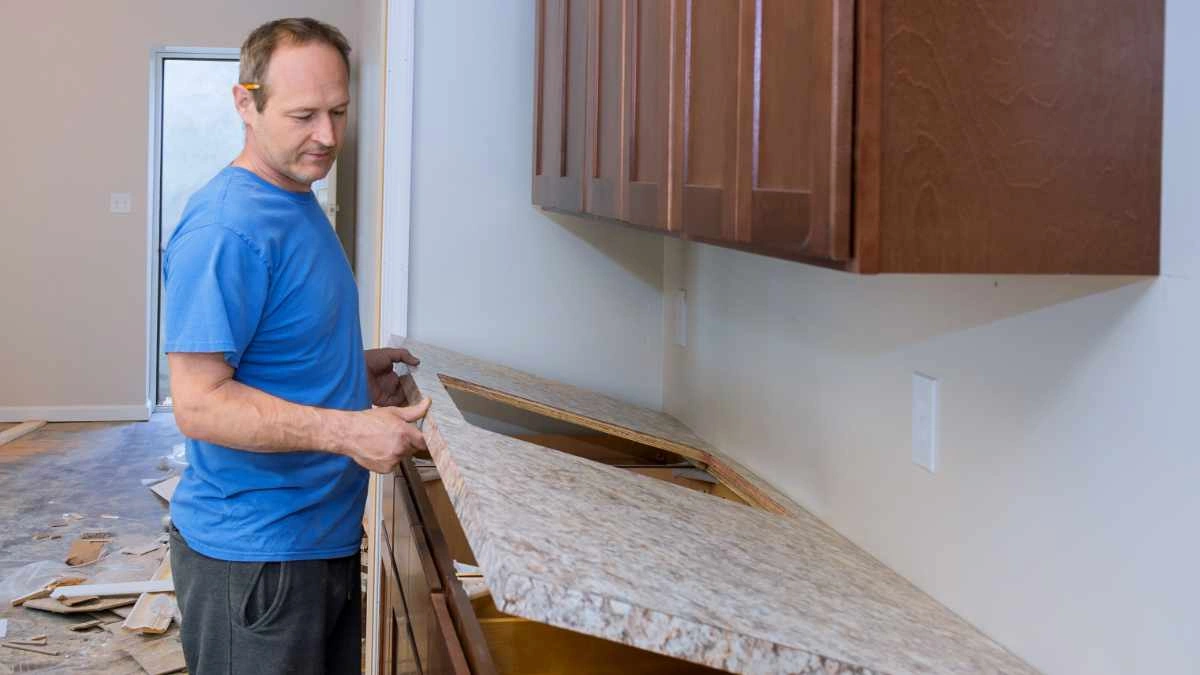
Your new countertop cannot go in until the old one comes out. Removal happens either the day before installation or the morning of installation day depending on how your fabricator schedules the project.
Removal time varies by material:
- Laminate countertops: 1 to 2 hours typically screwed from below and straightforward to detach
- Tile countertops: 2 to 4 hours grout lines and adhesive bonding require more work to remove without damaging the cabinet boxes underneath
- Existing stone countertops: 2 to 3 hours heavy slabs require multiple people and careful handling to avoid cracking during removal
Some homeowners handle removal themselves to save on project costs. This works reasonably well for laminate. For heavy stone or bonded tile, professional removal is worth the cost improper technique damages cabinet tops and plumbing connections that are expensive to fix.
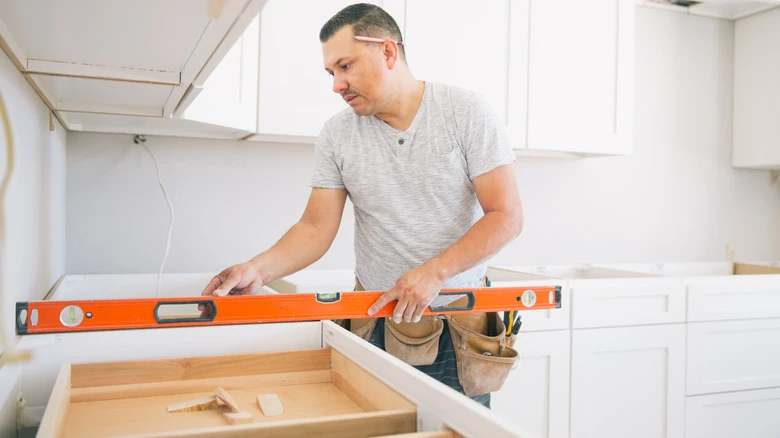
After removal, the installer inspects the cabinet tops for levelness and structural integrity. Unlevel bases get shimmed at this stage. Addressing this before the new countertop goes in prevents cracking, rocking, and poor seam alignment issues that are much harder to fix after installation.
Step 4 — Installation Day (Typically 1 Day)
Installation day is when the project comes together. Here is exactly what to expect during countertop installation from start to finish.
Morning: Arrival, Delivery, and Dry Fit
The installation crew arrives with your fabricated countertop sections. A standard kitchen typically breaks into 2 to 4 pieces with seams placed in low-visibility locations inside corners, against walls, and away from sink areas where possible.
Every piece gets a dry fit before any adhesive is applied. The crew checks seam alignment, edge overhangs, wall contact, and cutout positioning. Any fit issue is addressed at this stage. With digital templating, this process is fast and usually confirms everything is correct. In older homes with walls significantly out of square, minor adjustments are occasionally needed.
Midday: Setting, Securing, and Seam Bonding
Once dry fit confirms accurate placement, pieces are secured to the cabinet bases with silicone adhesive and mechanical fasteners where the design requires them.
Seams between countertop sections are bonded with color-matched epoxy and clamped under pressure while the epoxy cures. Each seam typically needs 30 to 60 minutes of clamped cure time before the clamps can be safely removed. In a kitchen with two or three seams, this step alone occupies a meaningful portion of the installation day.
Afternoon: Cutouts, Caulking, and Edge Work
Sink cutouts are made on site in most cases. Cooktop cutouts are typically completed during fabrication for tighter precision. The crew then works through the final list:
- Fitting and caulking all joints where the countertop meets the wall
- Applying silicone under the countertop lip where it contacts cabinet faces
- Completing final edge polishing at seam locations to achieve a consistent finish
- Confirming all cutouts are clean, properly sized, and ready for fixture installation
A standard kitchen with 30 to 50 square feet of countertop, one seam, and one sink cutout takes 3 to 6 hours from crew arrival to completion. A larger kitchen with an island, multiple seams, and complex cutouts takes a full day.
How long does it take to install quartz countertops versus granite on installation day? Installation time is nearly identical for both. The same placement, seam bonding, and edge finishing process applies regardless of material type.
Step 5 — Final Touches and Cleanup (Same Day)
The installation crew completes several final steps before leaving:
- Caulking all wall and backsplash joints with color-matched or clear silicone
- Cleaning epoxy residue from seam areas and bringing them to a consistent sheen
- Removing all packaging, cardboard, and installation debris from your kitchen
- Walking through the completed installation with you to confirm every detail
Do your walkthrough carefully before the crew leaves. Inspect every seam under natural light. Run your hand along every edge. Check wall joints for consistent caulk lines. Note anything that concerns you immediately it is significantly easier to address issues while the crew is still on site with their tools and materials in hand.
What Can Affect the Countertop Installation Timeline?
These factors can push your total project timeline shorter or longer than the 10 to 21 day standard.
Material Type
Quartz and granite follow nearly identical fabrication schedules. Marble requires slightly more careful fabrication handling due to natural stone characteristics like veining and fissuring. Porcelain slab countertops are growing in popularity but may have longer fabrication windows at shops with less experience cutting large-format porcelain.
Kitchen Size and Complexity
A small bathroom vanity can be templated, fabricated, and installed in under 10 business days. A large kitchen with an island, L-shaped runs, and multiple room connections takes 3 to 4 weeks particularly during peak spring and fall renovation demand.
Permit Requirements
Standard countertop replacement does not require a permit in most jurisdictions. If your project involves relocating plumbing, adding a new sink position, or structural changes to support heavy stone, permits add processing time. Your contractor will confirm what applies to your specific project.
Plumbing Reconnection
Sink plumbing must be reconnected after countertop installation before your kitchen is fully functional again. Some countertop installation companies handle basic plumbing reconnection as part of the project. Others do not. Confirm this before your project starts coordinating a plumber separately adds scheduling time if it is not addressed early.
Seasonal Demand
March through October is the peak season for countertop installation. Fabrication shops and installation crews are at full capacity. If your timeline is flexible, scheduling your project between November and February typically means shorter fabrication lead times and more flexible installation scheduling.
You can read about: How Much Does It Cost to Install Countertops
How to Ensure a Smooth Countertop Installation Process
Good communication between you and your fabricator is the single most effective way to keep your project on schedule.
Prepare Your Space Before Installation Day
- Clear everything from countertops and under-sink cabinets the evening before
- Disconnect your garbage disposal and dishwasher drain or confirm the installer handles disconnection
- Clear a direct path from your entry to the kitchen for carrying countertop sections
- Protect flooring in the installation path with drop cloths or cardboard
- Have your sink, faucet, and any other fixtures on site and ready
Coordinate with Your Fabricator and Project Coordinator
- Get your installation date and arrival window confirmed in writing the week before
- Ask specifically who handles plumbing disconnection and reconnection and confirm it is booked
- Verify your slab has been physically pulled from inventory and reserved with your project name
- Confirm that sealing is included in your installation service for natural stone surfaces
- Have a direct contact number for the installation crew on the day of the project
After Installation: What to Expect
Silicone Cure Time
The silicone adhesive and wall caulk need 24 hours to cure fully. Avoid placing heavy items on countertop edges or pressing against wall joints during this window. The countertop surface can be used lightly after a few hours.
Seam Visibility
Seams on stone countertops are visible when examined closely particularly on material with bold veining where the pattern does not continue across the joint. This is normal and expected on natural stone. Quartz seams are typically tighter due to the consistent pattern and uniform thickness of engineered stone.
Sealing
- Granite: Needs sealing before first use and annually thereafter
- Quartz: Non-porous no sealing required
- Marble: Needs sealing immediately after installation and more frequently than granite
Your fabricator should seal natural stone countertops on installation day before leaving. Confirm this is included in your service agreement before the project starts.
First 48 Hours
Use only warm water and a soft cloth for any cleaning needs during the first 48 hours. Avoid all chemical cleaners while silicone and epoxy seam bonds complete their cure. After 48 hours, switch to a pH-neutral stone cleaner for all ongoing maintenance.
Ready to Start Your Countertop Project?
You now have a clear picture of the full process from template appointment through installation day and what happens after. That knowledge puts you in a better position to plan your project, communicate with your fabricator, and avoid the surprises that come from unrealistic timeline expectations.
The fabricator you choose matters as much as the material you select. Accurate templating, quality fabrication, and experienced installation are what separate a countertop that looks perfect for decades from one that has problems from the start.
Prestigious Custom Cabinets provides professional Countertops Installation Services in North Lindenhurst for kitchens, bathrooms, and specialty applications. Our team handles the complete process templating, fabrication coordination, removal, and installation with clear communication at every step. Contact us today for a free estimate and a realistic project timeline for your specific kitchen.
Final Thoughts
How long does it take to install countertops? From the first template to complete installation, plan for 10 to 21 days for most standard kitchen projects. Installation day runs 2 to 8 hours depending on your kitchen’s size and complexity.
The fabrication window accounts for most of that timeline and it is not time that can be cut without affecting quality. Prepare your space, communicate clearly with your fabricator, and confirm all the details before installation day. Those habits make the difference between a smooth project and a frustrating one.
Frequently Asked Questions (FAQs)
How long does it take to install countertops in a small bathroom versus a large kitchen?
A small bathroom vanity countertop typically completes in 7 to 10 business days from template to installation, with the install itself taking 1 to 2 hours. A full kitchen with an island and multiple countertop runs takes 10 to 21 days total, with installation running 4 to 8 hours for the crew depending on complexity.
How long does it take to install quartz countertops compared to granite?
Fabrication and installation time is nearly identical for both materials, typically 7 to 10 business days for fabrication and 2 to 8 hours for installation day. Quartz may be marginally faster to fabricate due to its consistent engineered composition. Both materials require the same installation process: dry fit, adhesive, seam bonding, cutouts, and edge finishing.
Can I use my kitchen the same day countertops are installed?
Light use on the countertop surface is possible within a few hours of installation. For full use running water at the sink, heavy items near edges wait 24 hours for silicone adhesive to cure completely. Avoid all chemical cleaners for 48 hours while epoxy seam bonds reach full strength.
What to expect during countertop installation in a large or complex kitchen?
Expect a full day for large kitchens with islands, multiple seams, and complex cutouts. The crew dry-fits all pieces before applying adhesive. This careful process takes more time in complex layouts but ensures everything lines up correctly. Plan to be home for the full day and clear the kitchen of all items the evening before.
How long after countertop installation before the stone should be sealed?
Most professional countertop installation companies seal natural stone on installation day before leaving. If sealing was not completed, wait 24 hours for all adhesive and caulk to cure before applying sealer. Use a quality penetrating impregnating sealer appropriate for your specific stone granite, marble, and quartzite all benefit from sealing before first use.